TREP French Spring Washers

Product Overview


TREP French spring washers maintain continuous axial tension in bolted assemblies subjected to high vibration and thermal cycling. The conical geometry flattens under installation torque, storing elastic energy to compensate for joint micro-movements, gasket creep, and thermal expansion. Production utilizes progressive stamping followed by controlled-atmosphere heat treatment to stabilize spring rates and prevent fatigue failure.
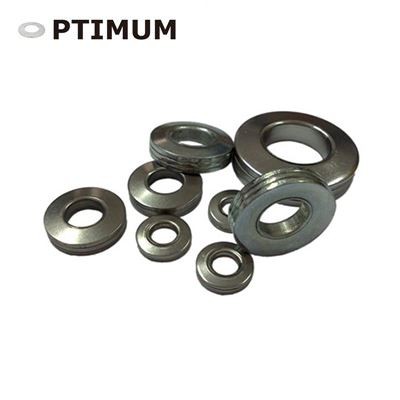


Product Types & Configurations

Standard Conical (Type A):

Smooth surface finish engineered for general industrial machinery, switchgear, and structural joints requiring uniform preload maintenance.

Serrated / Grooved (Type B):

Single- or multi-point biting edges on inner or outer rims that mechanically grip mating fastener surfaces to resist rotational loosening under dynamic loads.

Stacked Configurations:

Arranged in parallel to multiply load capacity at fixed deflection, or in series to multiply deflection at fixed load within constrained spatial envelopes.


Key Features


Dynamic Load Retention:

Maintains constant clamp load when joints undergo thermal expansion, shock, or lateral shifting.


Compact Radial Footprint:

Delivers high spring force within a minimal outer diameter compared to traditional helical lock washers.Delivers high spring force within a minimal outer diameter compared to traditional helical lock washers.


Fatigue Resistance:

Controlled grain flow through multi-stage progressive dies minimizes stress concentration points under cyclical loading.


Materials & Surface Options


01

Spring Steels:

C67S (1.1231) and 50CrV4 (1.8159) selected for high tensile strength, elastic limit, and resilience.

02

Corrosion-Resistant Alloys:

Stainless steel (AISI 301 / 316) and phosphor bronze deployed for chemical processing or marine environments.

03

Coatings & Finishes:

Zinc flake coatings rated for over 720 hours of neutral salt spray resistance without red rust; zinc plating with clear passivation; plain finish with rust-preventive oil.

productcate-1200-550


Applications


Heavy-duty electric motor mounts and electrical switchgear busbar connections.

01

Automotive transmission housings and chassis suspension joints.

02

Railway track fastening systems and signaling equipment.

03

Flanged pipe joints operating under high-temperature cycling.

04


Manufacturing & Quality Control
Stamping:
High-speed mechanical presses (160T-400T) equipped with progressive dies maintaining dimensional tolerances within +/- 0.05 mm.
Heat Treatment:
Continuous belt furnaces utilizing endothermic gas atmospheres for precise quenching and tempering to achieve target hardnesses of 42-52 HRC.
In-Line Testing:
Automated optical sorting systems verify outer diameter, inner diameter, and thickness; computerized load-deflection test benches measure spring force at specific working heights per production batch.


Customization & OEM


Non-standard outer/inner diameters and custom thicknesses engineered to client CAD models.


Tailored load-deflection curves calculated via finite element analysis (FEA) for proprietary mechanical assemblies.


Custom laser-etched packaging and lot traceability labeling aligned with rigorous supply chain protocols.


FAQ


Q: How do French spring washers differ from standard split lock washers?

A: Split washers rely on a biting action that often flattens out under high torque, resulting in total loss of elasticity. French spring washers utilize controlled elastic deflection via conical geometry to store mechanical energy, maintaining active tension against bolt relaxation.

Q: What is the standard hardness range, and how is hydrogen embrittlement prevented?

A: Parts are heat-treated to 42-52 HRC. For electroplated components, a mandatory baking process is executed within 4 hours of coating at 190°C-200°C to drive out absorbed hydrogen and eliminate delayed brittle fracture risks.

Q: Can these washers be reused after joint disassembly?

A: Reuse depends entirely on remaining elastic deformation. If a washer has not exceeded its yield point or suffered mechanical wear during initial compression, it can be re-evaluated via thickness and load testing, though critical safety joints mandate single-use replacement.

Q: What quality documentation accompanies production shipments?

A: Every batch ships with a material test report covering chemical composition and mechanical properties, dimensional inspection reports, and load-deflection verification curves upon request.

Q: What is the typical lead time for custom dimension tooling?

A: Prototype tooling and sample approval require 10-14 business days. Full production tooling and initial sample submission require 20-25 days from drawing sign-off.

Q: How are load-deflection tolerances controlled across high-volume production?

A: Statistical process control (SPC) monitors stamping thickness and furnace carbon potential, paired with 100% sampling on computer-controlled load test rigs to ensure spring rates remain within +/- 5% of nominal targets.

As one of the most professional trep french spring washers manufacturers and suppliers in China, we're featured by quality products and good service. Please rest assured to buy customized trep french spring washers made in China here from our factory. For more information, contact us now.

TREP French Spring Washers

(0/10)

clearall